






Wind loads on roof-mounted photovoltaic and solar thermal systems DG 489
BRE (Building Research Establishment) is an independent, research-based consultancy, testing and training organisation, operating in the built environment and associated industries.
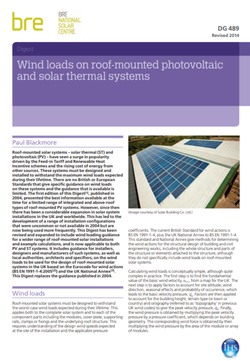
Wind loads on roof-mounted photovoltaic and solar thermal systems (DG 489) was written by Paul Blackmore and published by BRE on 22 May 2014.
Roof-mounted solar systems (both solar thermal (ST) and photovoltaic (PV)) have seen a surge in popularity driven by incentive schemes and the rising cost of energy from other sources. These systems must be designed and installed to withstand wind loads, but there are no British or European Standards that give specific guidance on wind loads on these systems and the guidance that is available is limited.
The first edition of this Digest, published in 2004, presented the best information available at the time for a limited range of integrated and above-roof types of roof-mounted PV systems. Since then there has been considerable expansion in solar systems, which has led to the development of a range of installation configurations that were uncommon or unavailable in 2004. As a result, the Digest has been revised and expanded to include guidance for a wider range installations and example calculations, and it is now applicable to both PV and ST systems.
It includes guidance for installers, designers and manufacturers, local authorities, architects and specifiers in the UK, based on the Eurocode for wind actions (BS EN 1991-1-4:2005) and the UK National Annex.
Its contents includes:
- Wind loads - determining the design wind load.
- Simplified method for determining peak velocity wind pressure, qpPressure coefficients.
- Designing free-standing solar systems on flat roofs to resist uplift, overturning and sliding.
- Fixing solar modules to the roof structure.
- Example calculations.
- References.
[edit] Related articles on Designing Buildings Wiki
- BRE articles on Designing Buildings Wiki.
- BRE Buzz articles on Designing Buildings Wiki.
- BRE National Solar Centre.
- BREEAM.
- Building Research Establishment.
- Five important factors to consider before installing solar panels.
- Large scale solar thermal energy.
- Renewable energy sources: how they work and what they deliver: Part 4: Solar thermal hot water systems DG 532 4.
- Solar photovoltaics.
- Solar thermal systems.
- Solar-assisted heat pump.
Featured articles
Check out some of the best features and news from Designing Buildings as well as key stories from around the web.

Sir Edwin Lutyens: Britain's greatest architect? Book review.

CIOB publishes free template to help assess and manage risks.
ECA's reflections on Party Conference season

Burnham wants to be confident of winning before asking for a fresh mandate.
New Chief Construction and Scientific Adviser

Sergio Cavalaro, Professor of Infrastructure Systems at Loughborough University.
Building safety levy for England

CIAT publish estimator tool for members.

Water sector faces a growing crisis that could slow the delivery of vital infrastructure.
Undervaluing our industrial past

Heritage value changes as taste for building styles changes.
Changing expectations around competence and compliance

New information sheet from CIAT.
Grenfell investigation files passed to CPS

Angela Rayner apologises on behalf of the British state.

Electrical contractors need to understand the practical implications.

The real barrier to getting more value from digital technology.

Your guide to The Construction Reset at UKCW Birmingham.